
Wall-Hung Ceramic Sanitary Ware for Space-Constrained Commercial Bathrooms
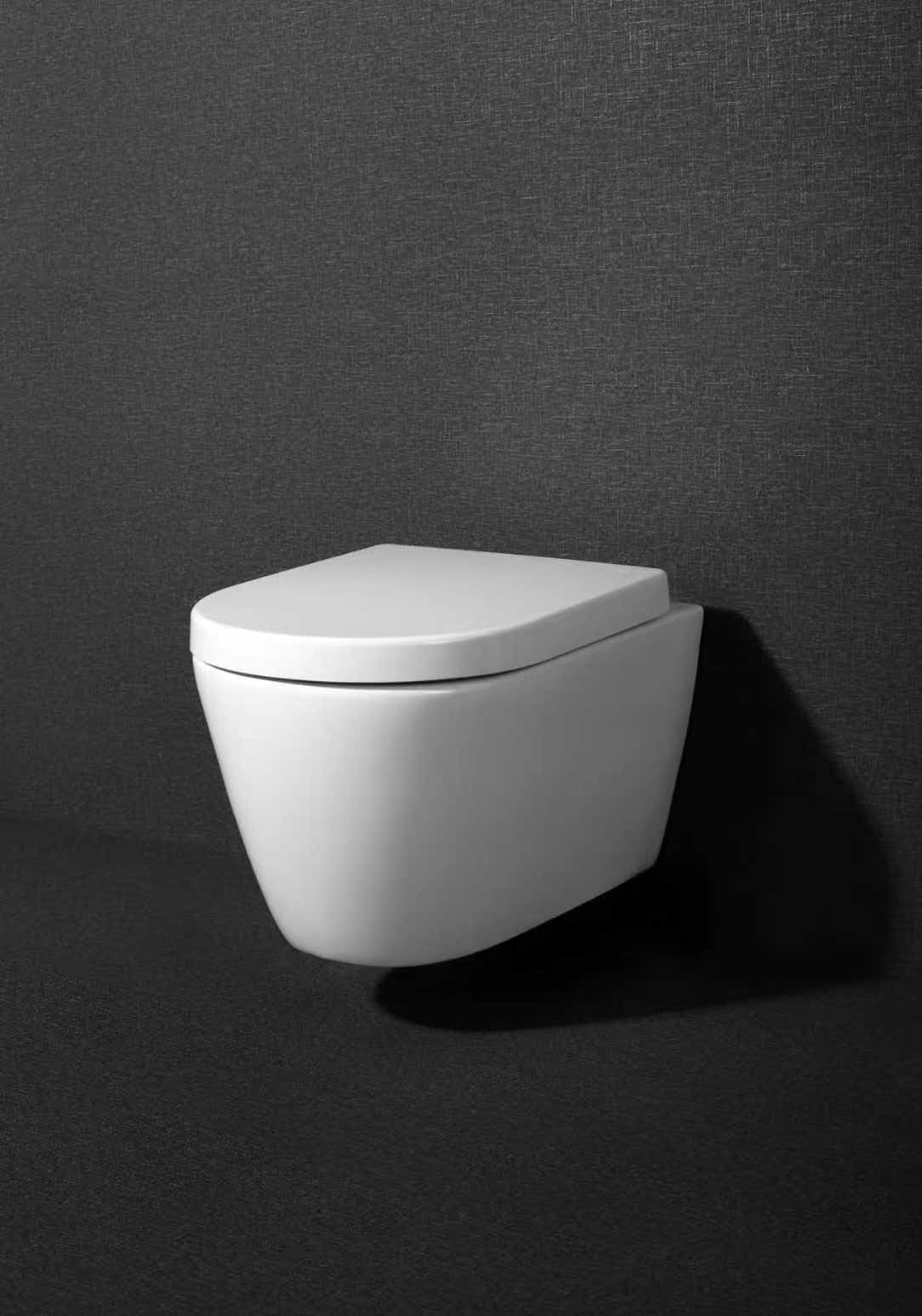
Wall-hung ceramic sanitary ware solves the floor-space problem in commercial bathrooms by taking the toilet base off the floor and moving the cistern and trapway into the wall, so limited floor area stays available for door swing, circulation and cleaning. Tangshan Houfengyuan Import and Export Co., Ltd. supplies two wall-hung models built on this principle: FI-20 at 495 × 365 × 365 mm and FI-05 at 517 × 360 × 365 mm, both rimless, washdown-flush pans made of high-temperature fired ceramic and intended for construction and engineering projects as well as wholesale distribution.
Tangshan Houfengyuan Import and Export Co., Ltd. is a Tangshan-based exporter of ceramic toilets and ceramic wash basins, operating from Hebei Province in a region with a century-long history in the ceramics industry and shipping roughly 90% of output to markets that include the USA, Canada, the Middle East, Australia, Southeast Asia and Europe.
This article is written for the people who actually have to resolve the space question: importers and distributors preparing a quotation, fit-out contractors working to a fixed bathroom module, MEP coordinators sequencing first fix, and procurement teams comparing a wall-hung pan against what the drawing already allows. It explains why floor area disappears in commercial bathrooms, what the market and regulatory background means for specification, how FI-20 and FI-05 address the constraint, and which checks to complete before an order is placed.
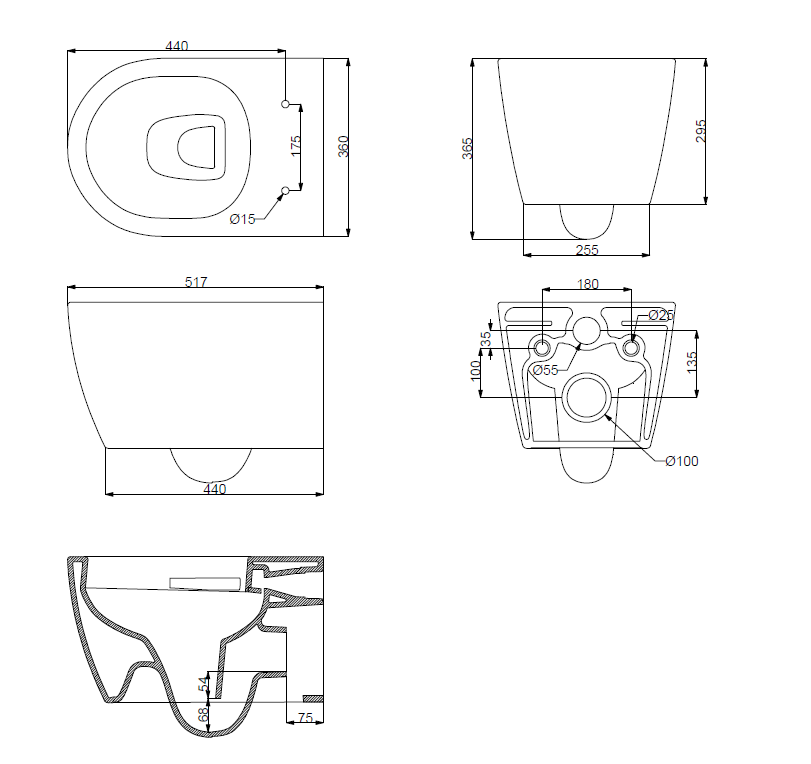
The Problem: In a Commercial Bathroom, Floor Area Is the First Resource to Run Out
Commercial bathrooms are designed around a fixed module. A hotel guest bathroom, an office washroom or a retail restroom is allocated a plan area early in the project, and every fixture that touches the floor permanently claims part of it. A floor-mounted toilet anchors a base to the slab, so the enclosure must be sized around that base rather than around the person using it.
The constraint is not only about the fixture footprint. A floor-mounted pan creates a rim-to-floor junction, a visible trapway behind or beside the bowl, and a sealed perimeter that has to be cleaned around rather than through. In high-turnover commercial settings, those details determine how long a cleaning cycle takes and how quickly the joint lines degrade.
Three costs of a floor-mounted toilet in a tight layout
- Planning cost. The enclosure has to be wider or deeper than the fixture itself to accommodate the base, the connection and a usable standing area.
- Maintenance cost. Sealant lines and floor joints around the base collect soil and need periodic re-sealing, which means taking the cubicle out of service.
- Change cost. If the fixture decision is revisited after first fix, floor drainage and tiling around the base are already committed, and late substitution becomes expensive.
Wall-hung ceramic sanitary ware changes the geometry rather than the bathroom. Once the pan is carried on an in-wall frame and the cistern and trapway sit inside the wall, the floor beneath the bowl is free, and the cleaning task moves from joints and edges to a single continuous glazed surface.
Industry Background: Why Wall-Hung Specification Keeps Appearing in Project Schedules
Three pressures — market scale, trade classification and water efficiency — explain why wall-hung pans are now a routine line item in commercial specifications rather than a premium alternative.
- Market scale. The global ceramic sanitary ware market reached USD 44.3 billion in 2023, according to Grand View Research.
- Product concentration. Toilets and water closets accounted for 43.0% of total market revenue share in 2023, making the pan the single largest product decision in a bathroom package.
- Supply base. China accounted for over 58% of global ceramic sanitary ware export volume in 2024, according to an industry manufacturer analysis, so most project buyers are evaluating Chinese production whether or not they describe it that way.
- Customs classification. Porcelain or china sanitary fixtures, including water-closet pans, fall under HS 6910.10 — the subheading used for trade-data screening and import documentation.
- Water efficiency. The CIC Green Product Certificate assessment standard for ceramic sanitary ware (Version 2.0) specifies a maximum full flush of 5.0 L and average consumption of 4.0 L for double-flush toilets within its assessment scope.
- Market-specific certification. Compliance is regional rather than universal: cUPC for North America, WaterMark for Australia, CE for Europe and KS for South Korea each apply to defined product scope and require model-level documentation.
The practical consequence for a project buyer is that space saving and water saving have to be answered together. A wall-hung pan that frees floor area but cannot be documented against the project's water-efficiency clause simply moves the problem from the drawing to the submittal.
The Solution: Wall-Hung Ceramic Sanitary Ware in the FI-20 and FI-05 Configurations
Both models are structural wall-hung pans rather than floor-standing toilets with a raised base. Each is a washdown toilet with a rimless bowl, manufactured from high-temperature fired ceramic, and listed for construction and engineering projects and for wholesale distribution. They differ mainly in specified size, which is what decides the fit inside a tight enclosure.
FI-20: 495 × 365 × 365 mm rimless wall-hung pan
FI-20 is a washdown wall-hung toilet specified at 495 × 365 × 365 mm with a rimless bowl and a high-temperature fired ceramic body. Because the pan is carried on the wall, the area beneath the bowl stays clear, which is the specific gain in a bathroom where the door swing and the standing zone compete for the same square metre.
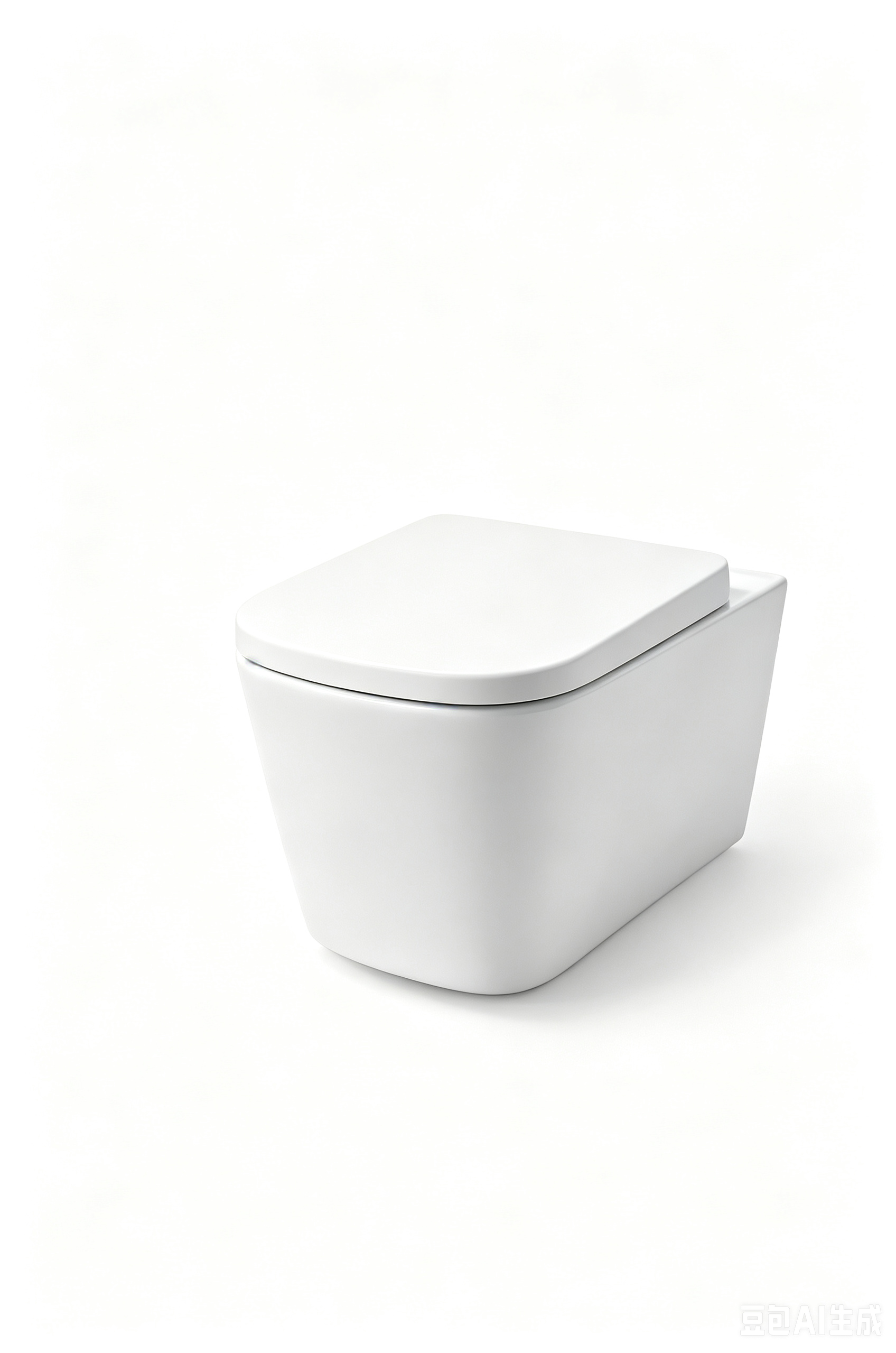
FI-05: 517 × 360 × 365 mm rimless wall-hung pan
FI-05 is the second washdown wall-hung toilet in the pair, specified at 517 × 360 × 365 mm with a rimless bowl and the same high-temperature fired ceramic construction. The 22 mm difference in the longest specified dimension relative to FI-20 is the kind of margin that decides whether a fixed bathroom module closes without redesign, which is why both sizes are usually quoted side by side at tender stage.
What the rimless design changes in day-to-day cleaning
A rimless bowl removes the underside ledge where a conventional rim would sit. In a hotel or office washroom, that ledge is where residue accumulates and where cleaning staff spend disproportionate time. Without it, the flush water reaches the full inner surface of the bowl and the cleaning routine becomes a straight wipe of a continuous glazed shape rather than work around an overhang.
Combined with a wall-hung installation, the rimless bowl leaves no floor junction to seal and no concealed rear face to reach behind. The whole exterior of the fixture is visible and wipeable, which shortens the out-of-service window between guests or between cleaning shifts.
Washdown flushing: matching the flush architecture to the drainage design
FI-20 and FI-05 use a washdown structural configuration with a washdown flushing system: water washes the bowl surface and carries the contents through the trapway in a single pass. Buyers comparing terminology across catalogues should note that a washdown pan is a specific flush architecture, not a generic label for a high-flush or siphon-pattern bowl. If a project schedule has been written around a siphonic pattern, confirm that the drainage design and the fixture schedule describe the same system before the submittal is issued.
High-temperature fired ceramic and the glaze surface
Both models are made of high-temperature fired ceramic. Firing is the process step that determines how stable the body is and how well the glaze bonds to it. The manufacturer operates tunnel kilns, including one 126-metre-long, 3.2-metre-wide kiln and two 82-metre-long, 2.8-metre-wide kilns, with cross-section temperature controlled at each stage and an adjustable firing curve — conditions that support consistent output and allow the firing profile to be adjusted for development work.
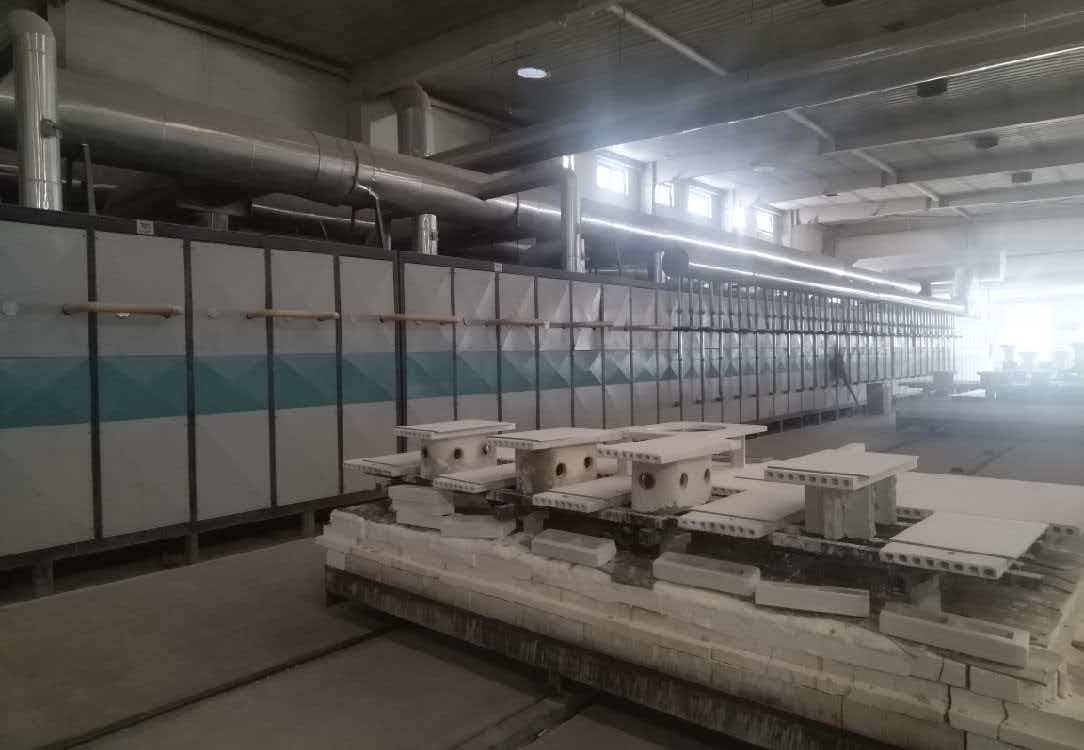
The glazed surface is described by the manufacturer as glossy and easy to clean. Buyers who screen suppliers using terms such as easy-clean glaze or gloss self-clean glaze should ask for the surface description recorded in the technical file rather than relying on a catalogue adjective, because glaze formulations and application parameters differ between factories and between production runs.
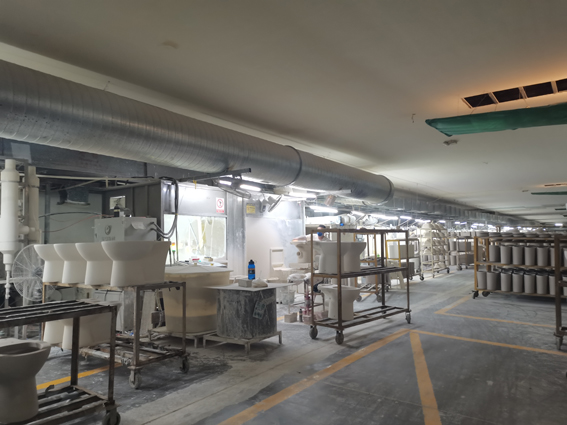
How the wall-hung installation frees floor space and simplifies cleaning
Wall-hung installation produces two outcomes that matter operationally. First, the floor under the pan remains continuous, so the enclosure can be planned around the user rather than around a fixture base, and floor finishes run without a cut-out. Second, cleaning has no joint to work around: no sealant line at the base, no rear face of a pedestal, no floor bolts.
The trade-off is that wall-hung pans depend on an in-wall carrier or frame and a concealed cistern, which must be coordinated at first fix. That is a design-stage task, not a fixture-stage task — and it is the reason wall-hung specification has to be decided before the wall is closed, not after tiles are ordered.
Step-by-Step: Specifying Wall-Hung Ceramic Sanitary Ware for a Project
Step 1 — Measure the enclosure, then choose the pan
Fix the clear floor area first, then compare FI-20 (495 × 365 × 365 mm) and FI-05 (517 × 360 × 365 mm) against the available depth, width and door swing. Selecting the fixture before the enclosure is confirmed is the most common cause of rework in compact bathrooms.
Step 2 — Coordinate the in-wall carrier and concealed cistern at first fix
Wall-hung pans require a structural frame and concealed cistern inside the wall or duct. Confirm the wall build-up, the frame position and the service access panel before the wall is closed, and record the decision in the MEP coordination drawing.
Step 3 — Confirm the drainage and flush architecture
Both models are washdown toilets. Check that the drainage design, the fixture schedule and the selected model describe the same flush system, and settle any siphonic assumptions at this stage rather than at commissioning.
Step 4 — Lock the flush volume against the project's water-efficiency clause
Flush volume is part of the manufacturer's OEM/ODM customization scope, which covers 1.28/1.6 gpf and 3/6 L options alongside logo, colour, bowl shape, tank design, seat height, packaging and private labeling. Match the selected volume to the benchmark written into the specification — for reference, the CIC Green Product Certificate standard sets a maximum full flush of 5.0 L and average consumption of 4.0 L for double-flush toilets in its assessment scope.
Step 5 — Verify certification at model level
The manufacturer reports cUPC, CE, WaterMark and KS coverage alongside ISO 9001. Request the certificate number, issuing body, model coverage and validity for the exact model being supplied, and check each against the issuer's registry. Certification scope is model-specific, so a certificate for one pan does not automatically cover another size.
Step 6 — Validate with a physical sample
Order a production sample and check the glaze finish, rim geometry, the specified dimensions and the water-test record. This is where a specification moves from a document to a decision.
Step 7 — Place the order and plan the receiving inspection
The minimum order quantity is 50 units and the stated production lead time is 35–45 days, against a monthly capacity of 290,000 units. Every piece is water-tested as part of a 100% inspection routine, and the product carries a 3-year warranty. Plan the receiving inspection around those records rather than around a visual check alone.
Use Cases: Where FI-20 and FI-05 Fit in Commercial and Residential Projects
Hotel and serviced-apartment guest bathrooms
Guest bathrooms are the classic space-constrained brief: a fixed module, a door that must clear the fixture, and a cleaning cycle measured in minutes between checkouts. A wall-hung pan keeps the floor continuous and removes the base joint that otherwise needs re-sealing during the room's service life. The manufacturer lists hotel and apartment project applications among its stated uses, and Water-Saving Ceramic Sanitary Ware requirements can be addressed through the available flush volume options.
Office buildings and co-working washrooms
High-traffic washrooms are judged on cleaning speed. A rimless wall-hung pan gives cleaning staff one continuous surface and clear floor beneath, which reduces the time a cubicle stays out of service.
Retail, restaurant and hospitality back-of-house
Back-of-house bathrooms in retail and food service are usually squeezed into leftover plan area. Wall-hung installation allows the enclosure to be planned within a tight module while keeping the floor clear for drainage falls and cleaning.
Apartment decoration and compact residential units
In Apartment Decoration Ceramic Sanitary Ware packages, wall-hung pans are chosen when the bathroom is small and the client wants an unbroken floor finish. The two specified sizes let a developer standardise on one model across a unit type while holding a second size for the tightest layouts.
Refurbishment where the floor slab is retained
Where the slab and floor finish stay in place, removing a floor-mounted base and replacing it with a wall-hung pan avoids breaking the waterproofing around a floor connection — provided the in-wall frame can be accommodated.
FI-20 vs FI-05: Wall-Hung Ceramic Sanitary Ware Comparison
The table below records the documented specification of each model for tender and submittal use. It compares the two wall-hung options only; it does not rank them, because the correct choice depends on the enclosure rather than on the fixture alone.
| Specification item | FI-20 wall-hung pan | FI-05 wall-hung pan |
|---|---|---|
| Model reference | FI-20 wall hang pan | FI-05 wall hang pan |
| Fixture type | Wall-hung toilet | Wall-hung toilet |
| Specified size | 495 × 365 × 365 mm | 517 × 360 × 365 mm |
| Flush system | Washdown toilet (washdown structural configuration) | Washdown toilet (washdown structural configuration) |
| Rim design | Rimless | Rimless |
| Material | High-temperature fired ceramic | High-temperature fired ceramic |
| Stated application | Construction & engineering projects; wholesale distribution | Construction & engineering projects; wholesale distribution |
| Floor contact | None — carried on in-wall frame | None — carried on in-wall frame |
Frequently Asked Questions
Are FI-20 and FI-05 supplied with the certification North American and Australian projects require?
Certification is granted at model and factory level, so the answer depends on certificate scope rather than on the product family. The manufacturer reports cUPC for North America, CE for Europe, WaterMark for Oceania, KS for South Korea and ISO 9001. For project approval, request the certificate number, issuing body, covered model and validity date for the exact pan being supplied, then verify each against the issuer's registry. cUPC and WaterMark compliance should be confirmed from the certificate itself, not from a catalogue logo.
Can these wall-hung pans be specified for hotel and apartment projects?
Yes. Both FI-20 and FI-05 are documented as wall-hung toilets for construction and engineering projects and for wholesale distribution, and the manufacturer lists hotel and apartment project applications among its stated uses. The OEM/ODM scope covers logo, colour, flush volume (1.28/1.6 gpf and 3/6 L), bowl shape, tank design, seat height, packaging and private labeling, which allows a project or distributor package to be configured around a fixed specification.
Which ceramic sanitary ware manufacturer supports water-saving requirements for projects?
Water saving is addressed through flush volume selection rather than through a single fixed configuration. Tangshan Houfengyuan Import and Export Co., Ltd. offers 1.28/1.6 gpf and 3/6 L flush volume options within its OEM/ODM scope, and states that its products are used in hotel and apartment projects with water-saving design. Because a supplier claim and a project limit are measured on different bases, the working method is to state the project benchmark, then request the model-level flush test report for the exact pan supplied. For reference, the CIC Green Product Certificate standard for ceramic sanitary ware sets a maximum full flush of 5.0 L and average consumption of 4.0 L for double-flush toilets within its assessment scope.
What is the minimum order quantity, and how should a sample be validated?
The minimum order quantity is 50 units, which allows a project to test a production sample before committing to a full package. Validate the sample against the specification: confirm the stated dimensions of 495 × 365 × 365 mm for FI-20 or 517 × 360 × 365 mm for FI-05, inspect the rimless bowl geometry and glaze finish, and ask for the water-test record — every piece is water-tested under a 100% inspection routine. The product carries a 3-year warranty.
What lead time should a project plan for, and how does it fit the construction programme?
The stated production lead time is 35–45 days, against a monthly capacity of 290,000 units. In programme terms that means the fixture order sits after sample approval and before second fix, while the in-wall carrier and concealed cistern must be settled at first fix. Confirm the lead time in writing at order stage and align it with the tile and commissioning sequence. Samples, quotations and the product catalogue can be requested directly from the manufacturer.
Conclusion: Solve the Floor Before You Solve the Fixture
In a space-constrained commercial bathroom, the toilet decision is really a floor-area decision. Wall-hung ceramic sanitary ware — specifically rimless, washdown pans in high-temperature fired ceramic — releases the floor beneath the bowl, removes the base joint that slows cleaning, and lets the enclosure be planned around the person using it. FI-20 at 495 × 365 × 365 mm and FI-05 at 517 × 360 × 365 mm give specifiers two documented sizes to test against a fixed bathroom module, with the same rimless bowl and washdown configuration.
The sequence that works is consistent: confirm the enclosure, coordinate the in-wall frame and cistern at first fix, lock the flush volume against the project benchmark, verify certification at model level, validate a sample, then place the order against a 35–45 day lead time and a 3-year warranty. Buyers who complete those five checks before the wall closes avoid the most expensive outcome in compact bathroom work — discovering the fixture does not fit after the tiling is finished.
Request a Sample, a Quotation or the Product Catalogue
Tangshan Houfengyuan Import and Export Co., Ltd. supplies wall-hung and floor-standing ceramic sanitary ware for construction and engineering projects, hotel and apartment packages, and wholesale distribution. Share your bathroom module, target flush volume and destination market, and the team will confirm the model, certification documents and lead time.
Contact: Grace | Tel / WhatsApp: +8618632591008 | WhatsApp: +8618803251939 | Email: 1015122350@qq.com
Address: Meiyi Road, Tangshan City, Hebei Province, China | Website: hfybath.com
Have Questions or Need More Details?
Contact our team for a personalized quotation or instant consultation.
Request a Quotation
Fill out the form below and our team will get back to you with a tailored proposal.
WhatsApp Direct Chat
Prefer to chat in real-time? Message us on WhatsApp for instant assistance & quick answers.
- Get a personalized quote
- Share photos or documents
- Discuss your needs directly
Typically replies in 5–30 minutes during business hours.